
For people stuck between “messy” and “hoarding”
Your home doesn’t need to be perfect. It needs to feel lighter.
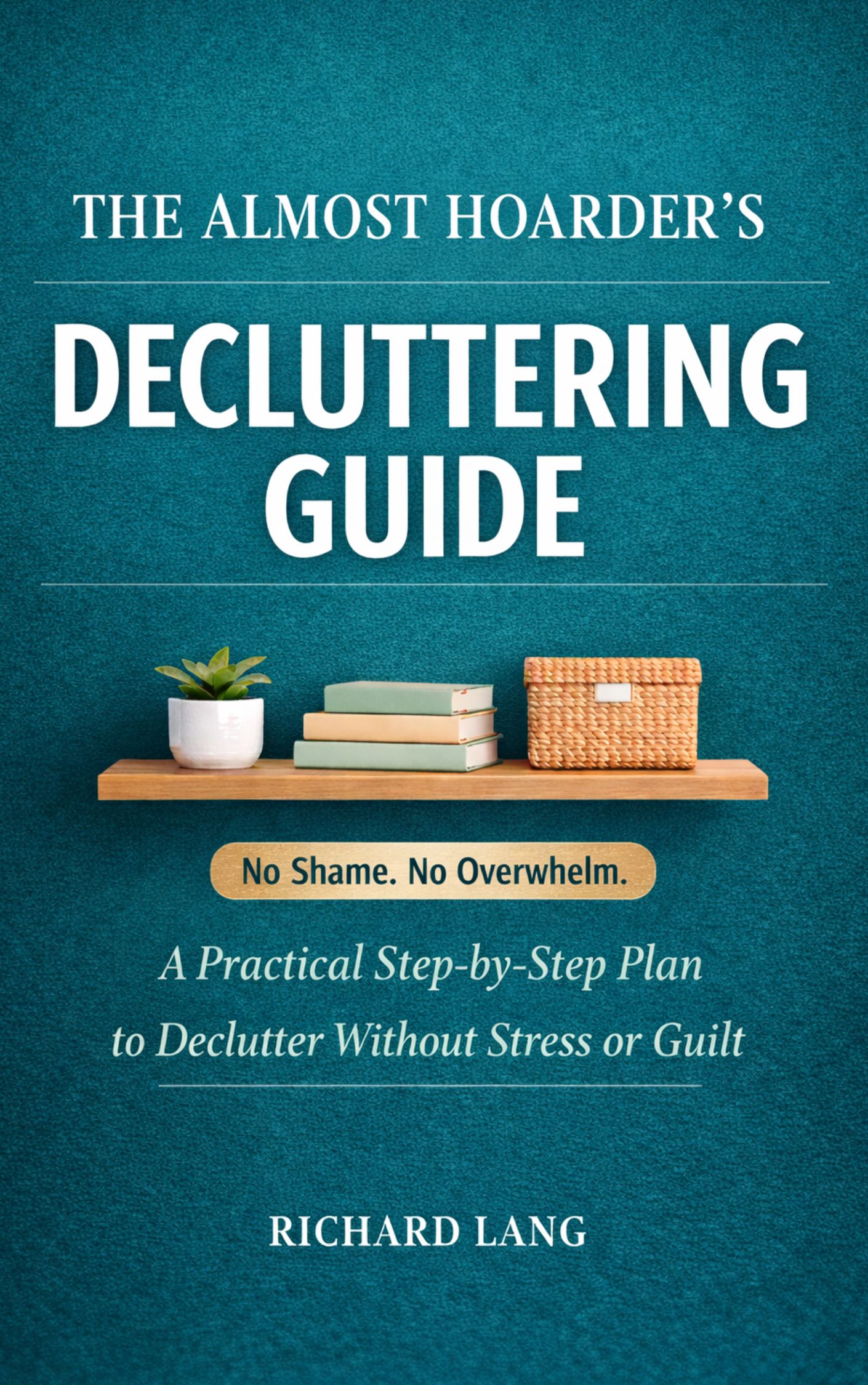
No shame. No overwhelm. No all-weekend purge.
The Almost Hoarder’s Decluttering Guide gives you a practical, step-by-step system for making faster decisions, clearing small zones, handling sentimental stuff, and keeping clutter from quietly taking over again.
Built for regular people with packed closets, crowded counters, too many “maybe someday” items, and no desire to become extreme minimalists.
START DECLUTTERING WITHOUT THE GUILT →Available on Amazon.
Who this book is really for
Not extreme hoarding. Not spotless minimalism. The middle.
Your home still works. You get by. But things feel tighter than they should. Closets are packed. Counters collect piles. Storage bins keep multiplying. You keep meaning to deal with it — and somehow the right time never arrives.
That middle ground is exactly where this book starts.
Does this sound familiar?
- You clean, but the house still feels crowded
- You own things mainly because “I might need it someday”
- You feel guilty getting rid of gifts or expensive purchases
- You have boxes, bins, or rooms you’ve been avoiding
- You start decluttering, get overwhelmed, then stop
- You organize things without actually reducing the volume
“Slow and steady isn’t lazy. It’s repeatable. Repeatable wins.”
The real problem
You probably don’t have a “stuff problem.” You have a decision-system problem.
The book reframes clutter as delayed decisions, emotional attachments, fast buying, slow sorting, and missing limits — problems that can be handled with clearer rules.
The Fast Decision Method
Use the same short filter over and over so every object does not become a courtroom trial in your head.
Zones, Not Rooms
Stop staring at an entire room. Finish one drawer, shelf, surface, or corner at a time.
The 30-Second Rule
If you’re still debating after about 30 seconds, the item is probably not a clear keep.
The One-Touch Rule
Pick it up, decide its direction, and move it there instead of shuffling it between piles.
The Signal Test
For sentimental items, separate real meaning from vague obligation so memories can be honored without storing everything.
The Stay-Ahead Rhythm
Use small daily, weekly, monthly, quarterly, and yearly resets instead of waiting for another giant purge.
The Fast Decision Method
Three questions. Same filter. Less mental drag.
Instead of asking the vague question “Should I keep this?”, the book gives you a tighter sequence.
Do I use this in my current life?
Not your old life. Not your fantasy hobby life. Your real, right-now life.
Is it actually hard to replace?
Expensive, rare, or critical is different from mildly inconvenient.
Does it earn its space right now?
Active value matters more than stored intention and “someday.”
The point is not reckless discarding. The point is making consistent decisions with less re-debating.
Sentimental stuff without the meltdown
Keep the memory. Question the volume.
Photos, gifts, kids’ artwork, family pieces, old identities — these deserve a different pace and a different filter.
The book’s approach is not “just throw it out.” It is to curate: keep the strongest signals, capture what can be photographed or scanned, use limits, and separate gratitude from lifetime storage.
The Signal Test
- Clear warmth or a strong memory? That’s signal.
- Vague obligation or “I guess I should keep this”? That’s noise.
- Could a photo or scan preserve the memory well enough?
- Can a container limit help you keep the best instead of everything?
Room-by-room without losing your mind
Rooms don’t get decluttered. Zones do.
The book deliberately starts with lower-resistance, high-use areas so visible wins build decision speed before you tackle the emotionally heavy spaces.
Kitchen
One drawer first. Duplicates, unused gadgets, mismatched containers, and crowded counters.
Bathroom
Small products add up fast. Clear what is expired, unused, or taking prime space.
Living Areas
Deal with homeless items, wandering mail, chargers, and surfaces that became storage.
Bedrooms & Clothes
Work category by category instead of emptying everything at once.
Paper & Office
Create one incoming paper path and reduce what no longer needs to live physically in the house.
Storage Spaces
Garages, basements, and memory-heavy areas come after decision skills are stronger.
Keeping clutter from sneaking back in
Maintenance rhythm — not maintenance marathon.
Stuff keeps entering your life. The goal is not to “finish forever.” The goal is to stay slightly ahead of the flow.
Surface reset
About five minutes on counters, tables, desks, and landing spots.
Exit & review
Something leaves: donation, trash, paper sweep, or a quick problem-zone pass.
Category trim
One light review of clothes, pantry, drawers, or another category.
Mini reset
Recalibrate the areas that quietly refill.
Deeper pass
Review larger categories before buildup becomes another major project.
Inside the guide
A practical system from understanding clutter to keeping it under control.
Questions before you buy
What kind of decluttering book is this?
Is this for severe hoarding disorder?
No. The book explicitly positions itself for people in the middle — not extreme hoarding and not extreme minimalism. It is not a substitute for therapy or mental-health care.
Will I have to empty entire rooms or declutter all weekend?
No. The method emphasizes small zones, short work blocks, and repeatable progress rather than heroic purge sessions.
Is this a minimalist book?
No. The goal is a lighter, easier-to-maintain home — not empty shelves or owning the fewest possible things.
What if I get stuck on sentimental items?
Sentimental items get their own method, including the Signal Test, curation, digitizing, and clear quantity limits.
What if I declutter and everything comes back?
The later chapters focus heavily on maintenance, input control, visible capacity limits, daily surface resets, weekly exits, and periodic trims.
Do I need special organizing products?
No. The book repeatedly emphasizes reducing first and organizing second. Basic supplies are enough to begin.
A useful filter
This guide is not about shame or perfection.
Probably not for you if…
- You are looking for treatment for severe hoarding disorder
- You want an extreme minimalist lifestyle
- You want a one-day miracle purge
- You want someone to tell you to throw everything away
Written for you if…
- Your home works, but feels heavier than it should
- You want simple rules instead of fuzzy slogans
- You need a method that works on low-motivation days
- You want less clutter without guilt or overwhelm
Start with one small zone
You don’t need to fix the whole house today.
You need a better way to decide what stays, what leaves, and how to keep the space from filling back up.
No shame. No overwhelm. Just practical rules you can repeat.
GET THE ALMOST HOARDER’S DECLUTTERING GUIDE →Available on Amazon.
This book is for educational and informational purposes only. It is not medical, psychological, mental-health, or legal advice. If you believe you may be dealing with hoarding disorder, severe anxiety, depression, trauma, or another mental-health concern, seek help from a qualified licensed professional.